


If you've ever stepped into a modern office lobby, a trendy bathroom, or a sleek retail space, chances are you've glanced at patterned glass and thought-wait, is that textured glass for looks, or does it do more than just catch light? As a patterned glass supplier, I get this question all the time, and lately, it's the one my clients hammer at most: Is patterned glass fire-resistant? The short answer isn't a simple yes or no, and that's exactly why I wanted to break down the science, the testing, and what you need to know before specifying patterned glass for spaces where fire safety isn't just a box to check-it's a necessity. I've been selling patterned glass for 12 years, working with architects, contractors, and building managers who've brought me projects from small cafes to 50-story skyscrapers, and I've seen firsthand how confusion around fire resistance can lead to costly mistakes (or even safety gaps). Let's start with the basics: what patterned glass actually is, because that's where the first piece of this puzzle lives.
Patterned glass isn't a single product-it's a category of flat glass processed with a textured, embossed surface during manufacturing (or sometimes post-processing) to diffuse light, obscure visibility, or add aesthetic depth. Think of the soft, rippled look of Rain Pattern Glass, the subtle, pebbled texture of Nashiji Pattern Glass, or the bold, structured lines of Figured Tempered Glass. Each pattern is designed for a specific vibe, but many clients assume this textured surface automatically makes it better or worse for fire-related uses. Spoiler: it doesn't. The fire performance of any patterned glass depends almost entirely on two things: its base glass type, and any additional treatments applied during production. The pattern itself is just a surface finish-it doesn't alter the core chemical composition or structural integrity of the glass. That's a critical point I make to every new customer, because I've had someone once order a beautiful, highly patterned shower glass only to panic when they realized it couldn't be used next to a kitchen stove. The pattern was perfect for their design, but the base glass was wrong for the fire zone.
Let's get into the fire science here, because it's less complicated than you might think. When glass is exposed to fire, it reacts in one of three main ways: it can soften, crack, or resist heat long enough to contain flames and smoke. Regular annealed glass (the kind you buy for basic windows or picture frames) is the most common patterned glass base, and it's terrible for fire safety. Annealed glass is made by cooling molten glass slowly, which creates internal stress. When it hits temperatures around 120–150°C (248–302°F)-that's not even a super hot fire, that's the kind of temperature you get from a small oven or a faulty electrical outlet-it expands unevenly, shatters into sharp, dangerous shards, and melts quickly. That's why building codes ban annealed glass from fire-rated zones like exit corridors, kitchen partitions, or stairwell enclosures. You can put any pattern you want on annealed glass-even the most intricate Figured Tempered Glass-but if it's base annealed, it's not fire-resistant.
So what does make patterned glass fire-resistant? The key is tempering, or heat-strengthening, the glass before (or sometimes after) embossing the pattern. Tempered glass is processed by heating annealed glass to over 600°C (1112°F) and then cooling it rapidly, which compresses the outer layers of the glass and puts the inner core in tension. This makes it four to five times stronger than annealed glass, and when it breaks, it crumbles into small, harmless pebble-like pieces instead of sharp shards. But here's the thing: standard tempered patterned glass is not fire-rated. Wait, I know that sounds counterintuitive, so let's clarify. Tempered glass can resist thermal shock better than annealed, which means it's less likely to shatter if exposed to sudden temperature changes from a small fire-but it still softens and fails under prolonged high heat. To get fire resistance, you need a different technology: fire-rated glass, which uses intumescent materials or laminations between glass layers to expand when heated, create a heat-resistant barrier, and stop flames and smoke from passing through.
Wait a second-can patterned glass be made with this fire-rated technology? Absolutely, and that's one of the most exciting trends I've seen in the last five years. As design demands have shifted, clients don't want to choose between a glass that looks good and a glass that keeps people safe. I recently worked on a hospital project where they needed patterned glass for a pediatric wing partition-they wanted privacy for kids' rooms but also fire protection in case of a kitchen fire on the floor below. We ended up custom-cut a heat-strengthened base glass and added a thin intumescent lamination, then embossed the Nashiji Pattern Glass texture on one side. The final product looked exactly like our standard Nashiji line, but it tested to meet 20-minute fire resistance rating, which is more than enough for that zone. Another example is the Tempered Patterned Glass Door we supply for office exit lobbies-we work with a manufacturer that embosses a subtle linear pattern on tempered fire-rated glass, and it's been used in over 30 commercial projects across the Southeast because it checks both aesthetic and safety boxes.
Let's talk testing, because this is non-negotiable for fire-rated glass. No patterned glass is fire-resistant just because it has a texture-It has to be third-party tested to meet international or local building codes. In the U.S., that means meeting ASTM E119 standards, which test how long a glass can withstand flames, heat, and structural stress. In the EU, it's EN 13501 standards. What does this testing involve? A sample of the glass is placed in a furnace that simulates a real fire, heated to over 1000°C (1832°F), and inspectors measure three things: integrity (can flames and hot gases pass through?), insulation (does the other side of the glass stay cool enough to not ignite nearby materials?), and radiation resistance (does the glass block enough heat radiation to prevent secondary fires?). Regular patterned tempered glass will pass the integrity test for a few minutes, but it will fail the insulation test almost immediately, because the unmodified glass conducts heat through. Fire-rated patterned glass, on the other hand, uses the intumescent lamination I mentioned earlier-when heated, that layer swells up to 50 times its original thickness, creating a foam-like, heat-insulating barrier that slows heat transfer. The pattern doesn't affect this process at all, as long as the lamination is even and the pattern doesn't create weak points in the glass surface.

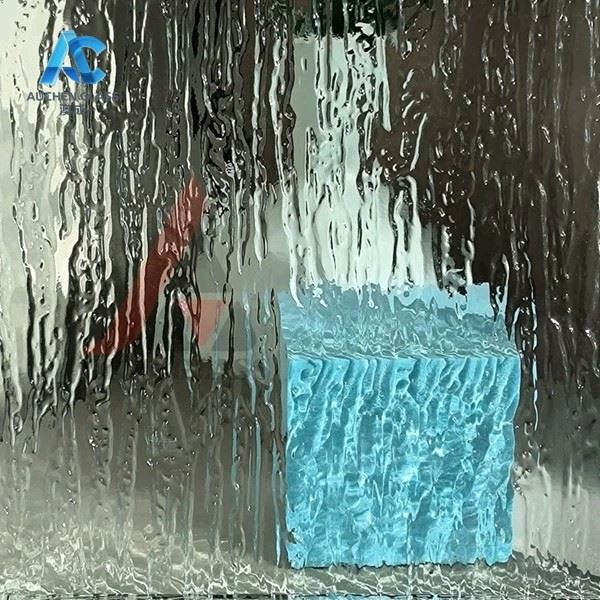
I get asked all the time: Can I use my favorite Rain Pattern Glass in my home's fireplace enclosure or kitchen backsplash? The answer is almost always no-unless it's explicitly labeled and tested as fire-rated. I once had a homeowner reach out to me last year, she'd bought a roll of self-adhesive patterned film to put on her kitchen window above the stove, thinking it would make the window fire-resistant. It took me 10 minutes to explain that film is not glass, and adding it to regular annealed glass above a stove is a huge safety risk-if there was a grease fire, the glass would shatter, and the film wouldn't stop flames from spreading. That's why it's so important to specify glass that's both patterned and tested for fire resistance, and to work with a supplier who knows the difference between decorative and fire-rated options.
Another common mix-up: heat-strengthened vs. fully tempered patterned glass. Heat-strengthened glass is heated to a lower temperature than fully tempered, so it's about twice as strong as annealed, but it doesn't break into pebbles. It can also resist more thermal shock than annealed, but like fully tempered, it's not fire-rated on its own. Fully tempered is better for areas that need impact resistance (like shower doors), but it's not fire-resistant unless it's modified. That's where many of our clients go wrong-they order a Figured Tempered Glass thinking it will work for a fire zone, but when it doesn't meet code, they have to start over. As a supplier, I've built my business on educating clients about this, not just selling glass. I'd rather tell a client that their favorite pattern isn't fire-rated than let them use a product that could put lives at risk.
What are the current code requirements for patterned glass and fire resistance? Let's break it down by common use cases, because that's what most people actually need. For residential spaces: If you're using patterned glass in a bathroom, living room, or non-fire zone, annealed patterned glass is fine, as long as it's rated for impact (like tempered if it's a shower). If you're using it in a kitchen backsplash above a cooktop, or a fireplace enclosure, you need heat-resistant glass-but regular tempered patterned is not enough. For commercial spaces: Exit corridors, stairwell enclosures, and areas within 10 feet of a commercial kitchen require fire-rated glass, which means patterned glass here must be tested and labeled. For institutional spaces like hospitals or schools, the requirements are even stricter, and the glass must not only be fire-resistant but also diffuse light enough to maintain privacy in patient rooms or classroom partitions.
I also want to address a concern I hear from designers: Does adding a pattern to fire-rated glass affect its performance? The short answer is no, as long as the pattern is embossed uniformly and doesn't create any sharp edges or weak points in the glass. We've tested our custom patterned fire-rated glass with Rain Pattern, Nashiji, and linear figured patterns, and all have passed ASTM E119 testing as long as we use the correct lamination and base glass thickness. The only time a pattern can be an issue is if a client tries to cut corners-like using a thin, 6mm glass instead of the required 8mm, or embossing a pattern too deep, which can create stress points that make the glass fail under heat. That's why working with a reputable supplier matters-we have in-house testing protocols to make sure every custom patterned fire-rated product meets code, before it leaves our warehouse.
Let me share a recent project that sums this up perfectly. A local architecture firm reached out to me earlier this year for a boutique grocery store they were designing. They wanted to use patterned glass for the checkout counter backsplash, the corridor partitions, and the storefront. The challenge? The corridor partitions needed to be fire-rated, while the storefront and checkout backsplash could be decorative. We pulled out our standard Rain Pattern Glass for the storefront and checkout-annealed, embossed, no fire rating needed, perfect for their bright, open design. For the corridor partitions, we used a custom version: heat-strengthened base glass, embossed with the same Nashiji Pattern Glass texture our clients love, laminated with an intumescent layer, and tested to 20-minute fire resistance. The final install looked seamless-you couldn't tell the corridor glass was different from the decorative pieces, but it met all commercial building codes. The grocery store opened last month, and the manager told me it's been a hit with customers, and the fire marshal signed off on all the safety documents without a single question. That's the sweet spot I love to help clients reach: beautiful design that doesn't compromise safety.
Before I wrap up, let's clear up one last myth: No patterned glass, regardless of pattern or treatment, is "fireproof." Fire resistance is rated in minutes-20-minute, 45-minute, 90-minute ratings, etc.-meaning the glass can withstand a standard fire test for that length of time. Even the highest-rated glass will eventually fail if exposed to fire for hours, but that's not the point: the rating is designed to give people enough time to evacuate a building, and for firefighters to contain the fire. So when a client asks me how long a particular patterned glass will last, I don't give a vague answer-I tell them the exact rating, and confirm it meets their local code requirements for their space.
As a patterned glass supplier, my top priority is making sure my clients have all the facts they need to make safe, informed choices. I've seen too many projects where a cheap, untested patterned glass was used in a fire zone, leading to code violations, costly reworks, and worst of all, safety risks. The good news is that you don't have to choose between pattern and fire safety-there are dozens of tested, code-compliant patterned glass options on the market now, from subtle rippled textures to bold, geometric figures.
If you're working on a project and have questions about which patterned glass is right for your space, or want to see samples of our fire-rated options, I'd love to hear from you. Whether you're a homeowner designing a kitchen, an architect planning a commercial build, or a contractor sourcing materials for a new space, we can walk through your requirements, share testing data, and help you find the perfect patterned glass that balances beauty, privacy, and fire safety.


